Description
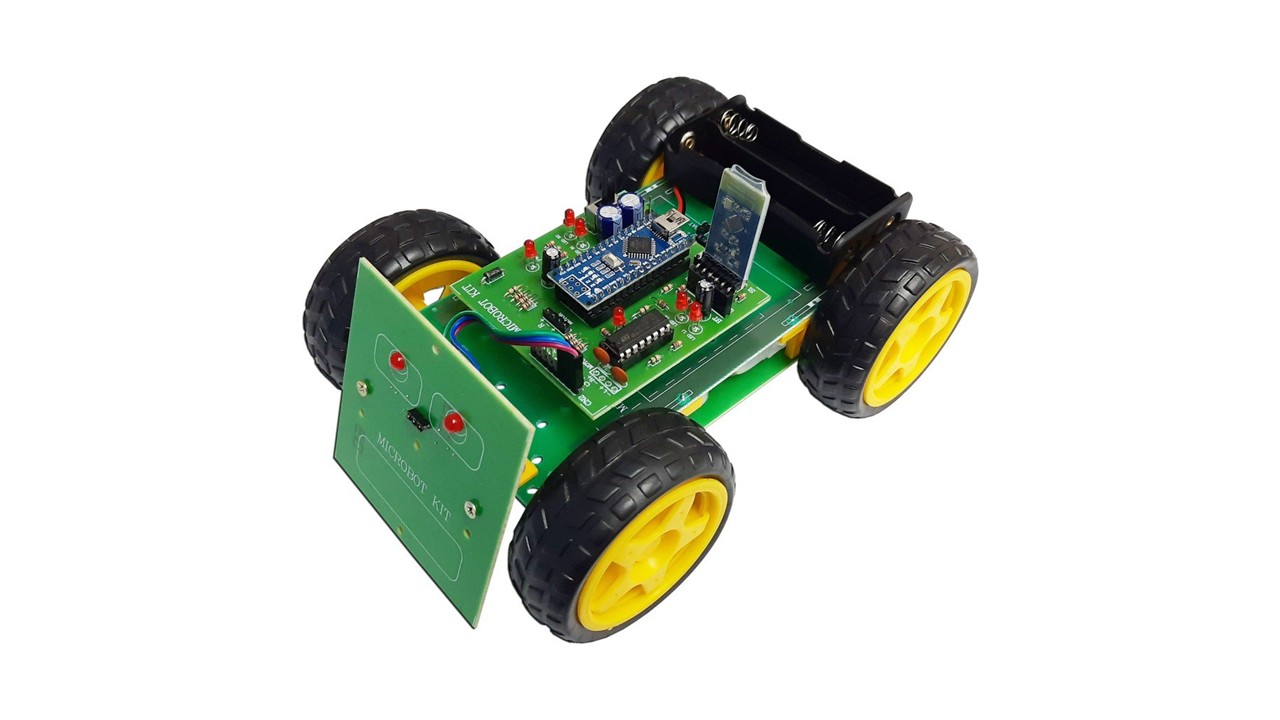
This 4WD robot is controlled wirelessly by using a Bluetooth signal as the medium of
operation. The advantage of Bluetooth is that it consumes less power than wireless WiFi
and is also popular when communicating with mobile phones. Besides that,
programming and app control work is also easier than the WiFi system. Therefore, it is
very suitable for those who are starting to learn wireless.
JDY33 was chosen as the Bluetooth module because it communicates with a wide variety
of devices such as computers, Android mobile phones and IOS systems.
The Bluetooth version is 3.0 SPP + BLE4.2 and operates at as frequency at 2.4GHz.
SPP transmission speed is up to 16K bytes/s and BLE type, up to 4 bytes/s.
Transmission distance up to 20 meters (in open air), maximum transmit power 6db,
and receiving sensitivity -96dbm.
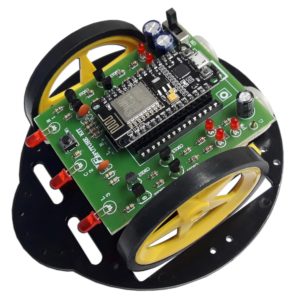
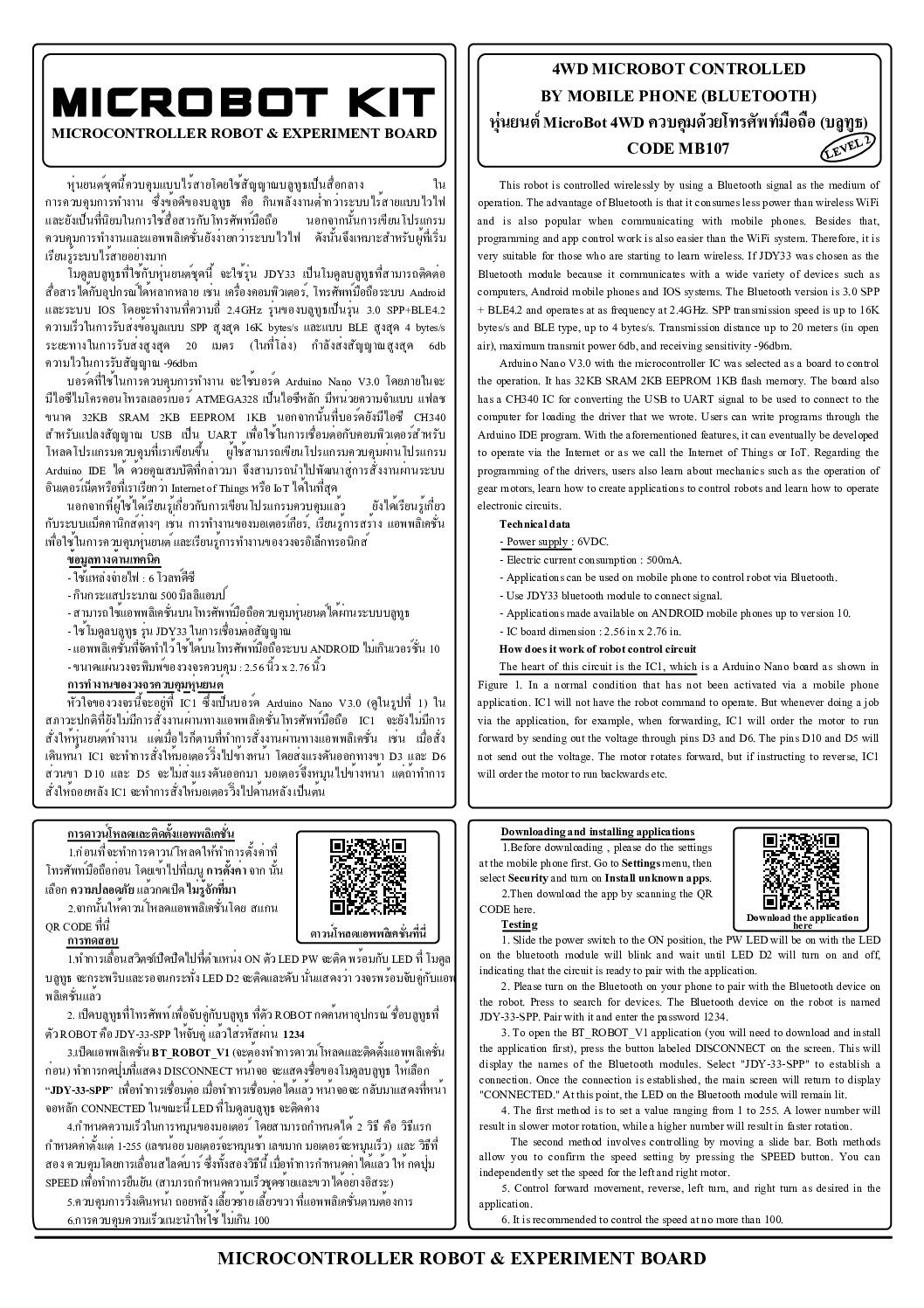
Arduino Nano V3.0 with the microcontroller IC was selected as a board to control
the operation. It has 32KB SRAM 2KB EEPROM 1KB flash memory. The board also
has a CH340 IC for converting the USB to UART signal to be used to connect to the
computer for loading the driver that we wrote. Users can write programs through the
Arduino IDE program. With the aforementioned features, it can eventually be developed
to operate via the Internet or as we call the Internet of Things or IoT. Regarding the
programming of the drivers, users also learn about mechanics such as the operation of
gear motors, learn how to create applications to control robots and learn how to operate
electronic circuits.
Technical data
– Power supply : 6VDC.
– Electric current consumption : 500mA (peak)
– Applications can be used on mobile phone to control robot via Bluetooth.
– Use JDY33 Bluetooth module to connect signal.
– Applications made available on ANDROID mobile phones up to version 10.
– IC board dimension : 65mm x 69.9mm (2.56 in x 2.76 in.)